


A Modest (Playoff) Proposal
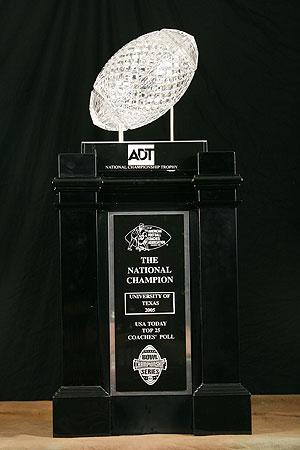 In what is almost certainly our most commented-upon post ever, Charlie gave an impassioned defense of the BCS structure as it stands today. While his opinion is certainly valid, and is one he shares with a number of other college football fans, I tend to see the debate in another light. For me, the only suitable way to crown a champion of NCAA Football is to play it out on the field. It shouldn’t come down to numbers, and computers, and subjective voters. Rather, we must allow 8 teams to make their case where it matters: on the gridiron, not on paper.
Charlie’s arguments are succinct enough. First, he claims that a team is only as good as it’s competition. Teams in BCS conferences typically face schedules with multiple ranked teams, and a conference schedule in which virtually every game is a potential upset. On the other hand, a BCS-busting team like Utah, Boise State, or Hawaii merely has to face watered down competition in their pursuit of perfection. And in the case of determining the top 2 teams in college football, Charlie might well be right, that usually, that team will come from one of the six power conferences.
Yes, it’s unlikely that one of the best two teams in college football in any given year will come from a mid-major conference. But it is also impossible to know whether this is fact or merely fiction. The old adage states that you can’t control who you play. Well, in college football this is mostly true, as each team’s conference slate is completely out of their hands. And though Charlie offers it as a throwaway option, joining a power conference is simply not an option for the majority of mid-major teams.
However, a weakened conference slate isn’t necessarily a reason to write off a team’s strength of schedule altogether. For instance, Central Michigan supplements their MAC schedule with games against Michigan State, Boston College, and Arizona, all three of which are on the road. Those three games are just about as tough as Penn State’s three toughest, playing Ohio State, Iowa, and Michigan State or Illinois. And the Chippewas aren’t the only mid-major team who have been ambitious with their non-conference scheduling. Fresno State has games set up against Illinois, Wisconsin, and Cincinnatti. And while Utah’s schedule wasn’t that difficult last season, they still had to defeat Oregon State, who finished one win away from a rose bowl bid, Michigan, who certainly seemed more difficult in the preseason, and TCU, who was consistently ranked in the AP and Coaches Polls. You can’t totally dismiss the schedules, especially in a time when the Big Ten and Big East don’t boast much heavier competition. And add in the fact that the Mountain West Conference, which you dismiss so, went 6-1 against the Pac-10 in regular season play, and you have something that is far short of being cut-and-dry.
Furthermore, the whole strength of schedule argument is bogus in and of itself. While it’s not easy to compare two sports, we need look no further than the NCAA March Madness Tournament to understand why reduced competition doesn’t lessen a team’s championship potential. Memphis and Gonzaga, for instance, come from two of the worst conferences in college basketball. The skill level, aside from those two teams, in the WCC and Conference USA is simply an absolute joke. The two leagues are consistently one-bid conferences, with those bids going to the perennial powerhouses. But that doesn’t stop Memphis and Gonzaga from acheiving significant success in the tournament, with each team reaching the Final Four in recent years, and Memphis coming a miracle three pointer away from winning the NCAA Championship. If these teams can, given the opportunity, achieve significant success, why couldn’t the same thing happen in college football?
So if we’ve established that strength of schedule probably shouldn’t come into play, what other arguments exist for leaving the mid-major teams out of a championship proposal? Could it be money, in the form of attendance figures and advertising rates? T.V. ratings? Frankly, if the BCS exists to crown a champion, and not to make money, then each of these arguments hold less water than a bucket with a hole in it. It shouldn’t matter what conference a team is in, or who they’ve played, or how much revenue they pull in if they’re truly great team. And I, among many others, consider Boise State’s and Utah’s efforts, in recent years, to be just that.
Are you going to claim that Utah, who has the same 2 BCS wins since its inception as Penn State is truly a lesser program? Sure,  they’ve dominated lesser competition, but they’ve beaten real good teams in big games. I won’t dismiss that blowout win against Alabama (the same Alabama team that came one game away from playing in the BCS Chanmpionship Game), as easily as you, nor will I discount their beatdown of Big East champion Pitt back in 2005. And how about Boise State, whose win over Oklahoma in the 2006 Fiesta Bowl might be the best game of football I’ve ever seen. That’s pure excitement right there. And I imagine it could’ve only been better if it meant the opportunity to move on and play for a championship. Sure, Hawaii got killed against Georgia in 2007, but that shouldn’t ruin it for everybody else. Non BCS-conference teams are 3-1 since the inception of the Bowl Championship Series. ACC teams are 2-9. When they’ve had the chance to compete on an equal playing field, it’s clear that non-BCS schools are just as good as their power conference counterparts. Why leave them out of an opportunity to play for the Crystal Football and the Championship? Because no matter how good that Utah or Boise State team is, they’ll never get the chance to be in the top 2. Charlie, you might see any school that isn’t fortunate enough to play in a BCS-conference as inferior by nature, but that’s just not the way it works. What system could possibly be less American than the BCS? If this is the land of opportunity, how can we tell the majority of schools and their football programs, and their fans, that no matter how good they’ll be, they’ll never be good enough to prove themselves worthy of the biggest stage in college football?
And that hasn’t even brought us to the equally ass-backwards thinking that has kept multiple legitimate, in your eyes, BCS conference teams from competiting for a chance at the championship. In 2004, LSU, USC, and Oklahoma each had 1 loss and an equal claim to stake for a spot in the championship game. Yet the BCS only allowed two of those teams to play on the field, resulting in a split national championship in which no consensus was reached, by fans, by voters, and by the media. But, no, having a playoff system to conclusively decide the situation is far less appealing than incurring controversy.
And that situation was topped the very next year, when an undefeated SEC team, in Auburn, was denied the chance at the NCAA championship game. Was it their fault that pollsters and computers deemed Oklahoma and USC more worthy of a title game appearance? What’s your answer, Charlie, and what’s the answer of BCS apologists for a damned good team from a power conference to get the shaft?
The only question is who’s next to get screwed. Penn State plays such an easy schedule in their nonconference that it’s not inconceivable to see them missing the championship game, even if they do run the table. When the media, in ESPN and it’s subsidiaries continue to spread the idea that the Big XII or the SEC are the best conferences in football, and that the Big East, ACC, and Big Ten are undeserving of being in their presence, when coaches with their own allegiances and computers which run on secret formulas are deciding the only two teams who can have a shot at the championship, then frankly, how can we even imagine that the BCS is beyond reproach? How can we begin to consider the idea that picking two teams, almost at random from a pool of deserving contenders, is more suitable for crowning the NCAA’s Champion than allowing 8 teams to play it on the field?
What follows is simply the easiest possible playoff scenario for the NCAA. Take the 6 BCS Conference Champions, the highest-ranked non-BCS school, and one at-large team. Seed them by BCS ranking. Let each of the playoff games be held at current bowl sites, and here’s the kicker: let the first round games be played at the nearest bowl destination to the higher seeded team. Sure, it makes the odds a little more difficult for the underdog, but it makes it easier to fill up arenas for three rounds. Think about it, if Penn State or Ohio State were to make the top 8 teams, and were ranked in the top 4, wouldn’t it be easier to fill up the Motor City Bowl in Detroit or the Eaglebank Bowl in Washington, D.C. than the Cotton Bowl in Dallas or the Peach Bowl in Atlanta?
 Whether you re-seed after each round is immaterial. Let the semifinals and finals rotate amongst the current BCS bowls. But make sure to start this thing in the middle of December, and we’ll have our Championship Game on January 1st, when the college football season is meant to end.
This is the easiest scenario to envision gaining acceptance. The BCS Conferences will still get their revenue and auto-bids, the BCS Bowls still get the chance to host meaningful and championship games, and the mid-majors finally get their chance to break through and win a championship. And we, as fans, get to benefit from finally seeing a true college football champion crowned. For everyone who says the regular season doesn’t matter, well, you’ve lost your argument. With the exception of one team, you’re going to have to win your conference championship to get a chance to play for the title. And instead of just a small handful of games that truly matter to us fans, we now have 7 games that become must-watch material.
Sure, there may be some flaws in my proposal, but not nearly as many as exist in the collective minds of pro-BCS arguments. Let the record show that in the mind of this fan, the BCS is just one letter too many, if you’re trying to determine who’s really the champion of college football.
If a playoff system is good enough for college basketball, for college football at it’s other divisions, and for every other sport, pretty much, that exists on the planet, why should Division 1 college football be the lone outlier? Why must college football continue to invite controversy and arguments from those of us who think that any team that gets left out is one team two many? If it’s for money, which it probably is, then how can we possibly consider it a legitimate enterprise?
The short answer? We can’t.


 Recommended for you

 Devon
Devon 
 Kevin
Kevin 