


How I Learned to Stop Worrying and Love the STEP Program
When the Penn State Athletic Department rolled out their plans for the Seat Transfer and Equity Program, there seemed to be a considerable backlash from the Penn State faithful. As minimum donation requirements increased, the student section moved, and fans who’d had season tickets for decades were faced with the prospect of losing their seats, the Penn State fanbase could only ask “Why”? Those echoes only reverberated louder and louder this offseason, as we heard about Big Ten expansion–the great revenues generated by the Big Ten Network, and from the conference’s television contracts with ESPN and ABC made it seem like Penn State, as well as any other school in the division, would be wealthy.
But that’s not the case. I had the opportunity to speak with Associate Athletic Director Greg Myford, who straightened out the story. Rather than swimming in funding, the athletic department would soon be operating at a deficit. Rather than force anyone out of their seat and out of Beaver Stadium, the first priority is keeping current ticket holders not just in the stadium, but in their seat. The complete Q&A is after the jump, and it should assuage anyone’s fears that the STEP program is merely a money grab.
quebecpenspinning: The Penn State Athletic Department is entirely self-sufficient, right, so that means there are no tax dollars, no tuition dollars funding any sports
Greg Myford: That’s correct.
NWO: So what challenges did you see in maintaining that equilibrium that prompted the implementation of the STEP program?
Penn State being late in the game in implementing something like that has on the one hand put us in a disadvantage with our fanbase, only because it is new and the way we’ve issued tickets has been the same way for a long, long, time. So now, to introduce not only a new way of doing things, but a way that requires more financial commitment, certainly we expected to, and we have, heard feedback from the fans.
NWO: What has that feedback been?
GM: The feedback we’ve gotten, it’s pretty interesting. It’s kind of falling into three distinct areas. One is the folks who are most disappointed by the overall introduction of the plan, and what it means to them. There’s another group that calls, and they’re not upset about what the plan means, they just want to make sure they understand it. They have a lot of questions, they want to understand what they have to do, in order to keep their tickets or participate in the plan. Then there’s the third group that either is a current season ticket holder or isn’t a ticket holder at all, but recognizes this as an opportunity to sit where they want to in Beaver Stadium, by agreeing to the new terms of the plan, and agreeing to pay the amount required to do so. It’s been an interesting program, like in most cases, sometimes what we tend to hear and what gets the most attention is the negative aspect of that.
Can you talk about the decision to implement this now as opposed to addressing the budget shortfall as it occurs, and increasing ticket prices incrementally?
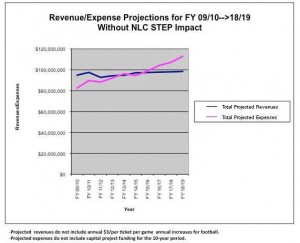
 There was some conversation of that. Although the shortfall won’t come until a few years out there are still several other initiatives that we need to address. I should back up and let you know that the shortfall is based only on operating expenses only. What that means is what is not forecast in those expenses are additional required capital improvements and construction. So, with the exception of the softball field, which is currently underway—when we look out, to the next ten years, it would be naïve not to think there will be significant expenses associated with either new or improved facilities. So if that number was not even in the expense line, our problem is that much more significant. So we knew we had to address the issue immediately. But we did talk about it—increasing ticket prices on an incremental basis. And when we looked at the numbers, when we looked at the levels that we’re asking for as far as season ticket holder participation, as compared to many of our peer institutions, we were comfortable in that what we’re asking is moderate in comparison. If we look at those top 25 programs, when we implement this program in 2011, we’re going to be in the middle of the pack when it comes to the annual commitment to buy season tickets for our program. From a financial standpoint, knowing where we knew we had to get to in terms of revenue generation, and what other peer institutions were asking, we are comfortable with where we ended up.
[Ed. note: For a list of schools with similar programs, which includes Michigan, Wisconsin, Iowa, Florida, Oregon, and Alabama, visit GoPSUSports.com]
There was a recent report on AOL listing athletic departments in terms of revenue, and Penn State ranked 6th, with virtually all that money coming from football. Was there any attempt to try and get more money out of the basketball program or the wrestling program, or other traditionally non-revenue generating sports, to take some off the burden of the football fans?
Well, that’s always a consideration, and it’s something we pay a lot of attention to on an ongoing basis. But the reality is that the numbers—whether it’s attendance-wise, or with the fanbase associated with those sports—really pale in comparison to football, and always have. In the grand scheme of things, there’s not really much of an opportunity to address our need with those other sports at this time. We’re always trying to grow those programs, but the impact those other sports can provide are minimized.
At the same time, we’ve seen the Athletic Department get very ambitious in replacing some coaches who have departed—in new hires like Cael Sanderson, Jeff Tambroni, and Bob Warming. Is that going to be a side effect of the STEP program: with more money coming in, will Penn State expect to be more competitive in non-football sports?

That’s the goal regardless of STEP, but I think it is safe to say that in general, the way we’re approaching the whole program, it’s important that our fans understand that Penn State athletics realizes there’s a risk in implementing this program. I’ve talked directly with fans who have told me that to introduce this plan either seems arrogant or seems presumptive on our part, but I can assure you there’s nobody here who thinks this way. We’re very aware that when we ask more of our fans, that they will accept more. So to come back to your question, that goes across the board in athletics. So I don’t think these recent coaching hires has anything to do directly with STEP, but we know that if we’re going to ask our fans to make the commitment make Penn State a top-tier program, let’s do our part to make this a top tier program.
From my personal experience, I can tell you that the Jets and Giants, in trying to fill their new stadium, have had to slash prices on their personal seat licenses, and have offered some sections with no PSLs. Is there any concern that you might have to roll back the minimum donations to ensure that you sell all your seats?
We don’t have any concern about that at this point, and we won’t do that. To do that would not be fair to the many who do support at the level that’s asked. But we also take a look at where we are from a straight business standpoint, to make the right decisions and do what we need to in order to generate the required revenue and make sure we’re maximizing the number of fans who can come and enjoy games at Beaver Stadium.
So how will this program change the current ticketing procedure, from the Nittany Lion Club points?
Well, the Nittany Lion Club is based on donations. Points are earned through money given. So, the more points you have, that’s a reflection of money you’ve donated.
But I’ve also heard reports from these individuals who have had tickets for a long time, and have the more desired seats, but don’t pay as much. So with this you’re opening up some of the better seats, so to speak.
First of all, it’s important to know that our first priority in this whole process has been to make sure that people currently in Beaver Stadium, that their first option is to stay right where they’re at, and not have to relocate at all. That is, of course, assuming that they’re willing to do so under the new terms of the STEP. This is not a reseating in that nobody is being told they’re out of their seat. With a few exceptions—where we’ve moved the student section, and the visitor seating, things like that. But for those where the seating itself isn’t affected, there’s nobody who’s going to be forced from their seat. Our first priority was making sure people had the opportunity to stay right where they are by providing the required donation. The traditional reseating is, basically, to pick everyone up out of their seat, and then reallocate based on how much they’re donating. But this is not that at all. That person you’re referencing, who’s been at the 30 yard line for 30 years, and is giving the minimum amount, they can still stay there. Granted, they’ll have to pay the new donation, but nobody is being forced to move. And just as importantly, if they make the decision that they don’t want to, or can’t pay that, we’ve left approximately 1/3 of the stadium seats at 100 dollars per seat, which is the current requirement. So those people have the option to move to those locations, and not see any increased donation.
With 1/3 of the stadium at the current minimum donation level, do you see that making it easier or more difficult for first-time ticket buyers to get season tickets at Beaver Stadium, especially younger individuals like recent graduates?
That’s a very interesting question, and I don’t know that I have the statistics to back it up, but I can give you a gut reaction based on my conversations, what we’re finding in the questions we’re receiving from individuals who don’t currently have tickets. There is a younger fanbase that is contacting us about how they could get tickets and they are not necessarily looking for the cheapest tickets. There is a certain percentage of the population out there that to this day doesn’t believe they can get a season ticket, and this program begins to reveal that you will be able to, and you can, and here’s how. This introduces to a much broader fanbase the possibility of coming to Beaver Stadium to come for games.
What concerns were given into moving the student section, and are there any plans in the works on how to accommodate traditions like the S-Zone and the Blue Band?
Certainly it was a concern, we wanted to make sure we explained to the students, and we want to make the students understand why we’re moving the student section. One of the primary reasons the student section is moving is so that we could adequately maximize the program we’ve put in place. I’ve heard the athletic department being accused of trying to cover up the movement of the student section with “making that end zone louder.” That’s very true, and that’s going to happen, but that’s not why the student section has been moved. I want to be clear: that’s not a reason that the Athletic Department is giving as to why the student section is being moved. It’s being moved as a result of our need to put the STEP program in place, and with the tickets near the 30 yard line bringing in the most revenue.
It’s not firm what we’re going to do with the Blue Band and S-Zone, but what I went in, and had several conversations with students, what I’ve said is “you tell me.” We know what the student section is, how big it’s going to be, where it’s going to exist. But I want to hear from the students, where the S-Zone should be, where the Blue Band should be. Obviously I’m talking to Dr. Bundy, and the Blue Band, because from a performance standpoint, we want to make sure they’re in the right place, so we don’t put them somewhere they don’t sound as good. With that the case, I’m really interested in hearing the feedback.
With the Big Ten Network—I don’t think anyone could’ve predicted the enormous success that the Big Ten Network has been. With the Nebraska in the fold, and as that generates more and more revenues for member schools, what implications could that have for Penn State athletics?
We haven’t been able to change revenue projections based on Nebraska’s addition to the Big Ten, and realistically, we think it would be premature to do that. We all believe Nebraska is a great addition, and know that they’ll provide a lot of excitement and enthusiasm for whatever sports they compete in, especially here on campus. But getting to the point of monetizing what that means, we haven’t gotten to that point.
But hypothetically, as the Big Ten Network continues to grow, and, with the STEP program in place, if the athletic department is running a surplus, where could we see that money go?
There has not been any consideration as to where that money would go. But if there started to be evidence that there would be significant incremental revenues that we weren’t counting on when the forecasting was done, I can say with certainty that those revenues would be considered for a number of things. We have a fairly long list of improvements we’d like to make, and we know that we can’t get to them all. I guess we’d feel good about being able to get to more of those things, or perhaps accomplishing those faster, than we were counting on. I’d look at all of our facilities, and what we need to do in those facilities, and some of our costs that we unfortunately can’t do much about, whether it’s travel, whether it’s medical costs, whether it’s utilities, stuff like that. From an operating standpoint, and increased revenue helps us address those challenges too. And it’s safe to say those challenges aren’t going away. But I don’t have any specific projects in mind, and I wouldn’t want to prioritize at this point, but that would help us address those things.
We’ve heard that Penn State needs to have 7 and a half home games per year in order to make things work. Might the STEP program allow for a change in the way the out-of-conference games are scheduled?
I don’t know if the STEP program has any direct impact on who gets scheduled, but I think certainly if it is successful, and as we begin to generate more revenues, it certainly could put us in a spot where we consider an additional neutral site game, or being able to take on an additional home and home series, as opposed to year after year having to get to that number of home games.
quebecpenspinning wants to offer its sincere thanks to Greg Myford for his time and expertise in breaking down the intricacies of the STEP Program. We hope this clears up some of the common misconceptions, but for additional information, please visit the STEP homepage on the Athletics website.



 Recommended for you

 Devon
Devon 
 Kevin
Kevin 